More MP3 guessing pattern with Mp3tag in Mac OS

I mentioned in my last MP3 series post that I had the material to write a new post regarding this topic and so today I’m fulfilling the promise I made. I’m going to show how you can use the powerful Swiss Army knife called Mp3tag (Windows “only” app) right within your Mac. Yes, you read it right. You can run Mp3tag using your Mac. Nowadays almost everything is possible… Open-mouthed smile

The great thing here is that there’s a way to use our beloved Mp3tag in Mac OS. I even asked a question at SuperUser where I was trying to find some similar software that I could use in Mac. Here’s the question: Alternative to mp3tag for Mac OS X. Well, after searching a little bit more I found a great site called PlayOnMac. What is PlayOnMac?

PlayOnMac is like wineskin, winebottler or crossover a piece of software which allows you to easily install and use in your Mac numerous games and software designed to run only with Microsoft®'s Windows®.

I then found Mp3tag bundle here. You get a .dmg file which contains Mp3 Tag.app (172.5 MB) on disk. Just mount the .dmg file with a double click and extract the .app file to your Applications folder in Mac OS dock. Doing this you have the power of Mp3tag right inside your Mac. No Windows virtual machine needed/no need to load your bootcamp Windows. It’s good because you’ll have more memory left for your Mac (in the case of a virtual machine) or you won’t spend your time changing the operating system (in the bootcamp case).

Ok, the bundle is a little bit lazy to load and the visual (retro) is Windows like but who mind?

There’s nothing better than a use case to showcase something. Today I need to organize some MP3 tags because their Track - Artist - Title fields are all a complete mess. Some data are already there and some are missing completely. I of course will use Mp3tag guessing pattern feature to solve this.

To get to the Guess values dialog window, click the Actions (Quick) icon in the toolbar and select Guess values in the dropdown menu. Screenshots can be seen here.

Here are the MP3 files before the process:

Mp3tag Guess Values for Track Artist and Title in FileName [ before ]Figure 1 - Mp3tag Guess Values Window for Track Artist and Title in File Name [ before ]

As you see most of the tracks have 1 in the Track field and Title and Artist fields are missing in most of cases. All the information that is missing is present in the Filename field. Really interesting fact.

Let’s take advantage of Filename info and fill the missing tags with that data. How? Using Mp3tag Guess values window.

Source format: %_filename%

Guessing pattern: %track% - %artist% - %title%

Really easy, isn’t it?

What the hell these % symbols are doing here? They are simple placeholders that tell Mp3tag about a specific pattern found in fields of MP3 files. In this specific case, Mp3tag will extract data from the Filename field ( source ). Looking at Figure 1 we see that all file names follow a pattern: Track # - Artist - Title. Such pattern is then passed to Mp3tag in the Guessing pattern field. With this input Mp3tag is able to infer/parse the file names and split them accordingly. Each part will then be used to fill the correct MP3 tags.

Here’s the post-processed MP3 files:

Mp3tag Guess Values Window for Track Artist and Title in File Name [ after ] Figure 2 - Mp3tag Guess Values Window for Track Artist and Title in File Name [ after ]

That’s a much better view and experience within your preferred Media Library software!

Things like this makes me really happy with computers…

Hope you find it as useful as it’s being to me in this hard task of keeping a MP3 collection organized. I at least try my best.

To see more ways of using the Guessing Pattern, check the MP3 series of posts.
Access web app from Parallels Win 7 VM in Mac OS

About a month ago I started the creation of an ASP.NET MVC 3 app to a buddy. I’ll write some blog posts in the near future sharing my experiences with this awesome web framework. This app I’m still developing is a web application that I develop using my "new” computer. Today I use Mac OS as my main operating system and since I’m using ASP.NET I also need to use Windows.

Parallels Desktop is the way to go to have a Windows virtual machine [ VM ] running side by side with Mac OS. This way you have the best of both worlds. I discuss more about Parallels Desktop here.

One of the things I wanted to do during the development was seeing how the app would look like when viewed in a different OS, in this case, I’d like to see it running in Mac OS as if I were an end user accessing the app. This is good to test how the app behaves when it’s viewed in a different environment, that is, the perspective/environment of the end user, and not the developer’s perspective/development environment.

It’s cool to see the app running in a different OS and different web browsers. In Mac OS I have the chance of testing it against Safari too. I also have the chance of seeing how exceptions are being handled. There are certain types of errors that only happen when the end user is using the app in his environment. I think you know that already. This kind of testing allows me to deliver a better user experience.

When the app is accessed from the Mac side, the first difference is mainly visual because my Win 7 VM has all visual effects (clear type) disabled and so things look really simple if compared to Mac OS. I’m running the VM with no visual effects so that I have a somewhat fast VM to do the development. I only have 4 GB RAM available and I have to share it with both operating systems. I thought 4 GB RAM would suffice but that’s not the case. I have already ordered 8 GB RAM but am eagerly waiting it arrive from US. That’s another story that I plan to write in other blog post.

The reason I’m writing this post is that things don’t work at first when you try to access in Mac your app that is running in Windows VM. To get things working from both sides ( host = Mac OS and VM = Windows 7 ) they must see/communicate with each other. That’s where I had to do some work to get things going. So here are some instructions of what you need do:

1 - Set a fixed IP address for Windows VM
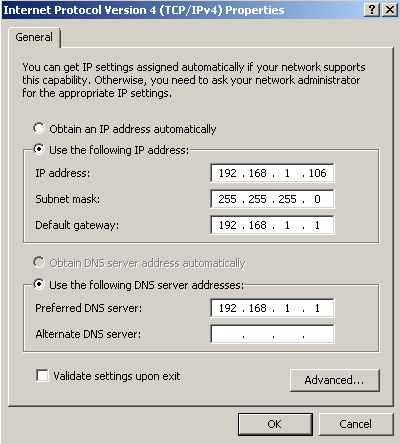
Set up a fixed IP address (read this page for a complete guide) in your Windows 7 virtual machine. This will make it easy when you need to access your app from Mac OS side. You won’t need to take note of different IP addresses handled by the DHCP server each time you restart your VM.

Windows 7 VM with fixed IP addressFigure 1 - Windows7 VM with fixed IP address

Above I have given the IP 192.168.1.106 to the VM. As I do not have a lot of devices connected to my wireless router, this IP is just fine.

2 - Set Virtual Machine’s Network Type
In your Parallels VM devices bar set your network type (orange arrow) as bridged:

Parallels Desktop VM devices toolbarFigure 2 - Parallels Desktop VM devices toolbar

3 - Test Communication between Host and VM
Make sure both operating systems can see each other.

Open Mac OS Terminal and execute a ping command:

ping 192.168.1.106

Change the IP with the IP you have in your Windows VM.

You should see something like this:

Mac OS Terminal pinging Windows 7 VMFigure 3 - Mac OS Terminal pinging Windows 7 VM

Now, open Windows 7 Command Prompt and ping Mac IP address. To see your Mac IP address go to System Preferences. Under Internet & Wireless, select Network.

Mac OS IP addressFigure 4 - Mac OS IP address

Let’s ping 192.168.1.100:

Windows 7 VM Command Prompt pinging MacFigure 5 - Windows 7 VM Command Prompt pinging Mac

As you see, both computers can see/communicate with each other. This means that the Network is working as expected.

4 - Configure Windows VM webserver for external traffic
What address should you type in a Mac OS browser to access the app? Well, this needs a little bit of caring. You’ll probably fail when trying to access the app with the same address you use in Windows side.

I’m using IIS Express as the web server in Windows. You can install it using Microsoft WebMatrix. IIS Express is by default configured to only server internal traffic (Windows VM). As I’m trying to access it from an external environment (Mac OS), I needed to configure it. The first link bellow was the main doc that helped me:

Serving external traffic with WebMatrix Beta
Handling URL Binding Failures in IIS Express (Serving External Traffic)

Basically I had to configure HTTP.SYS, create a URL binding that allow me to access the app in Mac side and disable Windows Firewall for my private home network.

4.1 - Configure HTTP.SYS
Type this command in Windows command prompt:

netsh http add urlacl url=http://leniel-pc:7777/ user=everyone

Change the url in the above command according to your desired configuration.

Note: the above command requires elevation. Right click the command prompt shortcut and select Run as administrator.

4.2 - Configure URL binding
As mentioned in the 2nd doc referenced above you must open your applicationhost.config file and add URL bindings that fit your needs. Mine is located here:

C:\Users\Leniel\Documents\IISExpress\config\applicationhost.config

Take a look at the last binding I have added:

<site name="FitnessCenter" id="3">

<application path="/" applicationPool="Clr4IntegratedAppPool">

<virtualDirectory path="/" physicalPath="C:\Users\Leniel\Documents\Visual Studio 2010\Projects\FitnessCenter\FitnessCenter.Web" />

</application>

<bindings>

<binding protocol="http" bindingInformation="*:7777:leniel-pc" />
<binding protocol="http" bindingInformation="*:7777:localhost" />

<binding protocol="http" bindingInformation=":7777:leniel-pc" />

<binding protocol="http" bindingInformation="192.168.1.106:7777:"/>

</bindings>

</site>

4.3 - Configure Windows VM firewall
The last step is disabling Windows VM firewall for your Home or work private networks.

Windows 7 VM FirewallFigure 6 - Windows 7 VM Firewall

As I just use this virtual machine to do software development, it’s ok to me to disable the firewall. Be careful though. Surprised smile

5 - Access Win 7 VM web app in Mac OS
After all this configuration you should be able to browse your app externally.

To see if everything is working, open a browser in Mac OS and try to access the app typing something as this in my case:

http://192.168.1.106:7777/

That’s it.

Hope it helps.

Batch renaming and copying MP3 values from tag to tag

This is just one more post in the MP3 series where I write about how you can organize your MP3 library/collection performing batch renaming to correct MP3 metadata and save time.

Just after I posted about Using Regular Expressions to correct mistagged MP3 I had other task to accomplish with Mp3tag but I didn’t know how to do that. What I want now is somewhat like what I showed in that previous post. The difference is that now I want to use the content of a given tag to fill another tag, thus copying/cutting that content from tag to tag.

As always I have a feeling that there must be a way of doing what I want and as always I go after it.

Here’s the problem this time:

Title tag has both the Title and Artist names and Artist tag has a wrong valuePicture 1 - Title tag has both the Title and Artist names and Artist tag has a wrong value

As you see in Picture 1, I have some MP3 files that have the Artist name included in the Title tag. The Artist name is between brackets while the Artist tag has the text Various. Obviously this is wrong because the Artist name should be in its proper Artist tag.

How can we correct this without manual intervention that would be a time consuming task?
The simple answer is using Mp3tag and its powerful set of features like the one called Guess values.

Guess values is so amazing that its window dialog just takes 2 parameters to get the job done. They are: Source format and Guessing pattern.

The Source format field in this case has the value %title% and the Guessing pattern field has the value %title% (%artist%). You can use any mp3 tag field between percent signs (%). What do these values mean?

Source format retrieves the value present in the Title tag of each MP3 and by guessing the values through the Guessing pattern it’s possible to split the Title tag according to the pattern. This opens up a world of possibilities where you can use any kind of combinations (masks/patterns) to split the value of a given tag and have those split values fill any MP3 tag of your choice.

So, in this case we have something as this happening behind the curtains:

Title: Begins With Me (Point of Grace)

Source format = %title%
Guessing pattern = %title% (%artist%)

Making the substitution, we have:

Guessing pattern = %Begins With Me% (%Point of Grace%)

With this, Mp3tag now knows what values it must use to fill the MP3 tags we want correctly.

Here’s the final result after you press the OK button present in Picture 1:

Correctly tagged MP3 files
Picture 2 - Correctly tagged MP3 files

Hope you got the idea and make good use of this.

I already have the material to write the next post in this series. Keep an eye in this blog. :)